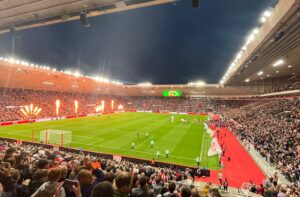
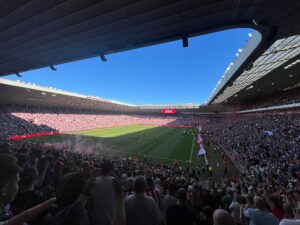
If a week is a long time in politics, a fortnight of supporting Sunderland AFC can seem a world away from each other.
Just two weeks ago, we had a morale‑boosting win at Elland Road which felt like a season‑defining moment. It was a performance filled with grit and determination and, given the team we fielded, it defied all expectations.
In a wider context, the result took on even greater significance. We had cracked the 40‑point barrier with nine games to go and had an FA Cup fifth‑round tie against League One “basement boys” Port Vale on the horizon. After a drop‑off in performances and results, this felt like the perfect palate cleanser to sustain us for the rest of the season.
In the interests of keeping you reading, I won’t dwell on the insipid cup exit or the latest league setback against Brighton, but our season is now in danger of petering out to an underwhelming conclusion.
Our next fixture could hardly come at a worse time. An away derby is an anxiety‑inducing prospect at the best of times but going into a trip to the People’s Republic of Saudi Arabia while sweating on the fitness of so many players is positively terrifying.
After the Newcastle game, we do not play again for three weeks, and going into that void on the back of a loss could sap the remaining enthusiasm and life out of our season.
This would be a huge shame, as much of our campaign has seen us hit heights that would scarcely have seemed credible if someone had suggested them back in August.
Before I explain why I remain positive about both our 2025–26 season and our prospects going forward, I acknowledge the concern among sections of our fanbase.
Firstly, the Port Vale game was a total and utter disgrace: the performance, lack of ideas and lack of urgency as the game got away from us cannot be denied.
We have also scored just one goal from open play in our last eight games in all competitions and have won just one in six in the Premier League.
I understand that for significant spells recently the football has been attritional and uninspiring, and perhaps even more alarmingly, we have looked increasingly vulnerable from defensive set‑pieces. From an attacking point of view, we have not looked like scoring from our own corners and free‑kicks which, given our lack of open‑play chance creation, is a major concern.
There is also a fair argument that Régis Le Bris has had four seasons in a row where blistering starts have tailed off in the second half, and some are starting to point to his perceived tactical rigidity and to question whether he is the man to help us reach our long‑term goals.
However, some of the reaction to our disappointing form and performances feels a little over‑the‑top, and it is important to retain perspective.
To be clear, harking back to previous underperformance is usually not a good argument to justify current shortcomings. For example, during our Championship days it was frustrating to hear our torrid League One era used to excuse a horrendous 2023–24 campaign. It can stifle progress if you are constantly thinking, “at least it’s not as bad as it was a couple of years ago.”
However, there is a balance to be struck when we analyse this season’s relative overperformance, and much of the context has been lost. During our last stint in the Premier League, which spanned ten seasons, we only broke the 40‑point barrier on three occasions, so to achieve that total with nine games to spare is no small feat. It is even more impressive as a newly‑promoted side, in a landscape where the gap between the Premier League and the Championship has rarely been bigger.
People will point to the money we spent last summer, which of course must be considered, but the context is key when assessing the impact of that spend. It is hard to know the exact levels due to undisclosed fees, but it has been widely reported that we spent £177m in transfer outlay over the course of the 25–26 season (not including add‑ons and agent fees).
At first glance this seems enormous and suggests merely avoiding relegation should not be the objective, especially after such a tough start. In reality, we still have the cheapest assembled squad in the Premier League and, let’s be honest, such a radical overhaul was necessary to compete at this level.
We have seen the impact of an injury‑ravaged squad in recent weeks, and, despite the outlay, we do not have the strength in depth that other squads have accumulated over time in the top flight.
I do not think enough credit was given to Le Bris and his staff at the start of the season for integrating so many new signings into the starting XI so quickly and impressively. It is perfectly valid to acknowledge that we played with more intensity, always looked like scoring late on, and, when we went behind, there was belief rather than widespread panic.
Our lack of response to going behind against both Port Vale and Brighton is far from good enough, and it is fair to acknowledge that we struggle to break down low blocks, especially when we have more possession than the opposition.
Once again, though, we must apply context. Game state is a big contributing factor to possession stats. When a team takes the lead, possession is often skewed in favour of the side that is behind, as the opposition sits in a compact shape and looks to transition. Therefore, it is not surprising to see us losing a high percentage of games where we have had more of the ball, particularly if we have fallen behind with plenty of time left.
I still feel this is something we need to improve, but as a newly‑promoted team, possession dominance is not something we have strived for at this level.
It also reflects a wider trend: football has become increasingly pragmatic. Naturally, the likes of Arsenal and Manchester City still dominate the ball, but we are not seeing the effortless control the Premier League elite once enjoyed. Football, for better or worse, has become a game of marginal gains, increased stoppages, set‑pieces and transitions.
Pep Guardiola has openly admitted that, due to fixture congestion, he no longer has the time on the training ground to coach the brand of football he became renowned for. This has been reflected in his decision to bring in Gianluigi Donnarumma, who is not renowned for being a sweeper‑keeper, and in signing Erling Haaland, who is a departure from the profile of striker he used to target.
For clarity, I do not expect sympathy for a man with almost unlimited funds and some of the world’s best players, but the shift from pragmatic football being a grim necessity to a tactic employed even by the crème de la crème of the English game is telling.
England coach Anthony Barry has also talked at length about the “dead zone” in modern football, where the ball gets stuck in midfield with one team compact and not ceding space, and the other trying to move them out of their rigid shape. In general, teams are content for the ball to be shovelled out wide while they retain a compact central block. I accept that the sight of a winger running down a blind alley before inevitably giving up possession is maddening, but it is usually because teams are well set up and actively want you to put balls into the box, backing themselves to defend it.
This is relevant to Sunderland because, while we all want to see attacking, front‑footed football, the standard of players in the league is at an all‑time high. As a newly‑promoted club we have been able to attract the likes of Granit Xhaka, Nordi Mukiele and Reinildo Mandava. This is reflected across the league, and the rise in technical quality and athleticism throughout mid‑table clubs is making stalemates more common. I don’t like it either, the entertainment value and randomness of the league have been lost to a degree, but it is the reality, and a radical change of approach would not necessarily benefit us.
As the season has worn on, numerous factors have led to our current malaise. Teams now seem to have a blueprint to frustrate us and exploit our weaknesses. At the start of the campaign we were a relatively unknown quantity, not in personnel, but in style and intensity. Not only has that now been figured out, but the underlying data has shown us to have among the lowest xG in the league, and we were clinical with the chances we did create. The problem is (and I include myself in this), when you are riding high you don’t want to hear about data or regression to the mean; you want to bask in the glory and pretend those days will last forever.
The reality is that the volume of late goals we scored was always going to be unsustainable, and our young squad was always likely to suffer burnout.
It isn’t as though results tailed off at the first sign of struggle. After a fairly presentable start, we worried about stagnation after our win over Wolves. With Chelsea, Arsenal and Everton on the horizon, we expected things to tail off, but we emerged from that challenge unbeaten. Then came a daunting December: we went to Anfield and got a point and in truth should have won. We also beat Newcastle and, as AFCON hit, we drew with Brighton, Leeds and Manchester City.
Now these results get lumped into our “bad run”, but we cannot rewrite history and pretend they were not excellent results at the time.
There is no doubt that our injury record and fatigue are partly down to a stretched squad squeezing every last drop out of themselves during the tricky, hectic Christmas period.
Le Bris often talks about finding solutions and connections, and he must do this between now and the end of the season.
Despite the positive picture I paint here, I am not pretending to be happy with recent performances or results. If this trend continues, the run‑in will feel long. But we cannot forget how impressive our season has been so far.